THE KALEIDOSCOPE PROJECT

Why AI is Failing the Public Interest

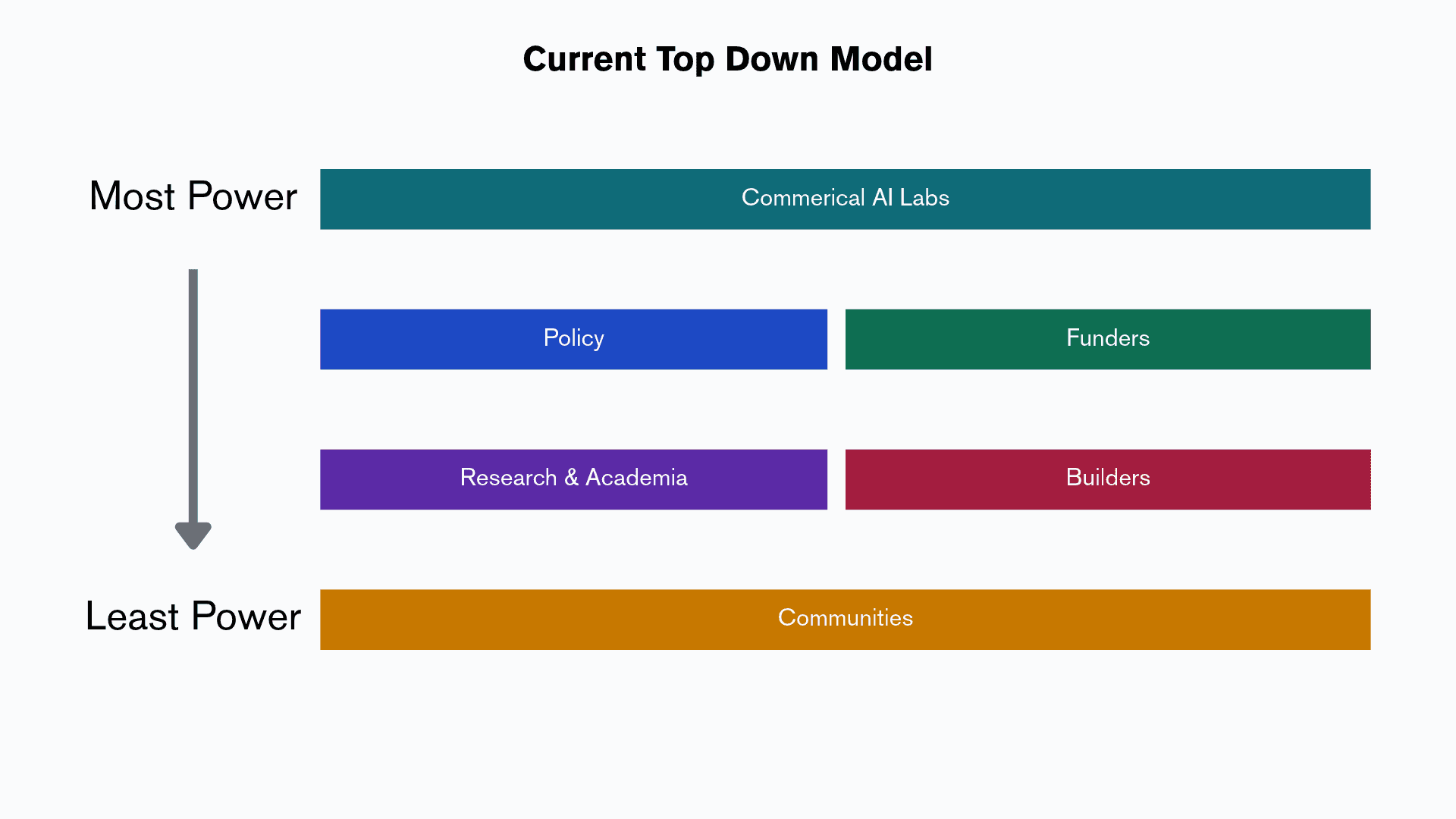
We have identified 6 Key Stakeholders in Public Interest AI elsewhere, each with unique power and positioning. Unfortunately, that power is not evenly distributed, and the most powerful and funded "AI for Good" efforts are a top-down push by Big Tech to facilitate market penetration during a time of light regulation, while avoiding accountability as they push risks downstream.

Downstream stakeholders are well-intentioned, but often end up passing harms and risks downstream as they are pressured by the dangerous, Big-Tech-aligned narrative of scaling or distributing frontier AI models without proper evidence of impact or user interest.

See how we think this top-down push can shift and how it fits into our Operating Hypothesis.

Top-Down Power Structure

Commercial AI companies

1 of 6

Why they hold power

  • Broad economic reach, with many products built on their models
  • Technical, opaque, fast-moving technology that is hard to regulate
  • Brand recognition and cultural influence

Passes down

  • Influence over policy, governance, and societal infrastructure
  • Market influence over venture capital and philanthropy
  • Harms that go unregulated
  • The limits on ethical trade-offs downstream

Uniquely has

  • Control over baseline model behavior
  • Capital
  • The ability to open up through open weights, published research, and red-teaming access

Could do better

  • Provide robust transparency
  • Respond to community needs rather than prescribe
  • Show that public well-being comes before commercial gain

Examples of The Top-Down Push

The current power distribution is primarily concentrated in AI labs, and secondarily in a subset of funders and governments. Builders and researchers sit below them, while end users have the least.

This inequitable distribution of power places the benefits and desires of Big Tech above all else, with the communities who are meant to benefit having the least agency.

See our approach in counterbalancing this problem.

Think that this work could be improved? We would love your feedback!